Healthcare System in Turkey
Turkey has excellent health services. The legal arrangement in the Constitution of the Republic of Turkey states, "Everyone has the right to social security", which gives access to health services to all residents. Both public and private health services are available and affordable.
Last Updated: November 2026

Continuous advancements in the medical sector have positioned Turkey's healthcare system among the global leaders across numerous specialties. Alongside rapid improvements in healthcare infrastructure, hospital bed capacity has also increased significantly with the opening of new medical facilities. Furthermore, high standards in medical training and a growing pool of specialists have elevated the country’s expertise in several fields like cosmetic surgery, ophthalmology, and cardiac care.

The Scope of Available Health Services in Turkey
Turkey offers comprehensive services in all fields, such as eye care, orthopedics and traumatology, internal medicine, otorhinolaryngology (ENT), gynecology, general surgery, dentistry, neurosurgery, dermatology, and pediatrics. The country particularly stands out in organ transplants, eye and dental care, plastic surgery, and hair transplantation. This broad range of high-quality services makes Turkey a premier destination for both health tourists and a growing community of global retirees.
Why Should You Choose Turkey for Healthcare Services?
Turkey has established itself as a global healthcare hub thanks to its high medical standards, mild climate, and strategic location that offers accessibility for 1.5 billion people across 3 continents within a 4-hour flight radius
One of the most significant factors that make Turkey one of the top nations in healthcare is the skill and experience of the doctors. Due to cultural perceptions and the structure of the education system, medical school remains the top choice for the country's brightest and highest-achieving students.
Moreover, given Turkey's large population, clinical specialists handle a remarkably high variety of cases compared to their counterparts in many other countries. This expands the chance of "on-the-job training" and gives specialists significant experience. Together, these two factors ensure an exceptionally high standard of medical staff across the country.
Turkey’s advantages in terms of healthcare services compared to other nations can be summed up as follows:
- Healthcare services that exceed global standards
- Strong technological infrastructure and high bed capacity
- A high number of accredited healthcare institutions and organizations
- Number of expert doctors in various fields
- Advanced innovative treatment techniques
- Competitive price level
- Personalized treatment plans
- Multilingual administrative staff
- Short waiting times
- Complementary and elective medication options, notwithstanding customary medication techniques
Every one of these highlights attracts health tourists visiting the country for treatment, and retirees looking to live a healthy life while benefiting from high-quality healthcare services.
Costs in the Health Sector in Turkey
While the primary attraction for international patients is the advanced medical care, cost-effective treatment plans are another major reason to choose Turkey. But this does not necessarily mean medical services in the country are "cheap". Rather, procedures are far more affordable compared to most European countries simply because of the overall living expenses in Turkey. According to the OECD's 2025 report (based on 2023 data), Turkey has the lowest healthcare price level among OECD countries, standing at just 18% of the OECD average, whereas Switzerland and the USA stand 52% above the OECD average.
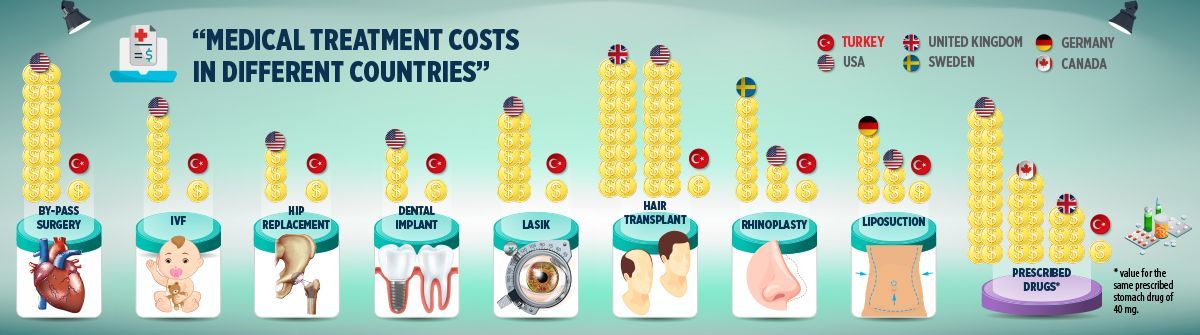
We can examine 2026 healthcare costs in Turkey through a few examples:
• The typical costs for hip replacement are around 7,500 USD to 12,000 USD in Turkey. The coverage depends on the package and often includes the prosthesis, hospital stay, and transfers.
• A single IVF cycle can typically be done for around 2,500 to 5,000 USD.
• Costs of laser eye procedures in Turkey vary across a broader range. The procedure can cost anything from 30.000 TL to 100.000 TL depending on the laser technology (such as LASIK, No-Touch, or SMILE Pro), corneal thickness, and the degree of refractive error.
• The cost of the angioplasty is between 600 USD and 1,200 USD.
• A single implant typically costs around 400 to 800 USD. Ranges of 300–520 USD have also been reported in Istanbul.
• Rhinoplasty costs in Istanbul are around 2,500 USD to 3,500 USD. There are also more comprehensive packages that range from 2,800 USD to 7,500 USD.
• Hair transplantation in Turkey particularly stands out for both quality and affordability. Typical costs are around 1,500 to 3,500 USD/EUR. Meanwhile, FUE packages in Istanbul generally range between 1,500 and 2,200 USD (or 1,650 to 2,800 GBP for 3,000 grafts).
• Liposuction, among the cosmetic procedures, is significantly more affordable in Turkey. While starting costs can be around 2,000 EUR, broader packages typically range between 2,500 USD and 7,500 USD.
A similar comparison can be made for prescription medications. The vast majority of medications in Turkey are considerably more affordable than their equivalents in the UK, the US, and other European countries. We can take a popular stomach medication (Nexium) as a reference: The same 40 mg version costs around 10 USD in Turkey, 40-60 USD in the UK, 85 USD in Canada, and often over 250 USD in the States.
How Can I Benefit From Turkey's Health Services as a Foreigner?
Turkey offers health and education services to all its residents. Numerous healthcare services are secured under the standardized social security system called General Health Insurance (GSS). To apply for voluntary GSS in Turkey, foreigners must hold a valid residence permit, have resided in the country uninterruptedly for at least one year, and not be covered by social security or health insurance in another country.
Application to the GSS is optional. International students have the right to apply within 3 months of their initial university registration. Required documents are a valid residence permit, proof of social security status from the home country, and a written undertaking form. Voluntary GSS premiums are updated annually in parallel with minimum wage increases. Additionally, when applying for a residence permit longer than one year, applicants who document that they started their GSS application are exempt from submitting a private health insurance policy. Otherwise, applicants for a residence permit must secure an annual private health insurance policy that covers both inpatient and outpatient treatments, along with prescription medications and medical devices.
Then again, under the Turkish Citizenship by Investment Program, purchasing real estate worth at least 400,000 USD (or its foreign currency equivalent) with a title deed annotation (prohibiting sale for at least 3 years) grants the right to apply for Turkish citizenship. Once they become citizens, the investor and their dependent family members gain full access to all public healthcare services under citizen status, without needing separate private health insurance.
GSS also covers the spouse and dependent children of a foreign national, granting access to all public hospitals as well as neighborhood family health centers (found in almost every neighborhood). Through the fully digitalized MHRS and e-Nabız integration, patients can easily book appointments online or by phone. This system significantly reduces waiting times across Turkey’s extensive healthcare network, even in Istanbul, where outpatient visits alone exceeded tens of millions in the first half of 2026.
While General Health Insurance (GSS) covers a broad range of healthcare services, it is not entirely free of charge, as co-payments, certain medication contribution fees, and charges for specific procedures may apply. Additionally, for foreign nationals, the treatment of chronic illnesses that existed prior to enrolling in GSS is excluded from coverage. Subject to these rules, key services covered under General Health Insurance include:
- Medical examination and consultation fees
- Prescription medication costs
- Surgeries and organ transplants
- Diagnostic biochemistry, microbiology, pathology, radiology, and medical imaging performed during inpatient treatment
- Post-operative physical therapy and rehabilitation
- Long-term treatments such as chemotherapy, radiotherapy, dialysis, and so on.
- Also, home care services for chronic patients, people with disabilities, and older individuals.
Can I Benefit from Public Health Services with a Turquoise Card?
Yes. Turquoise Card is a document that gives foreigners the right to work and live in Turkey. It is the Turkish equivalent of the USA’s famous Green Card and the EU’s Blue Card. The Turquoise Card aims to attract qualified individuals, researchers, and artists to Turkey. It also eliminates the long bureaucratic procedures and obstacles that foreign investors might otherwise face in their work and residency.
Although the Republic of Turkey allows dual citizenship, numerous nations don't. The Turquoise Card enables individuals to obtain work and residence permits in Turkey without losing citizenship in their nation of origin. Cardholders can work without problems like a Turkish resident and benefit from the same level of General Health Insurance. In fact, Turquoise Card holders have the same rights as Turkish citizens, aside from military service, the right to elect and to be elected, and to work in public institutions.
How Much Does Private Health Insurance Cost in Turkey?
Private health insurance costs in Turkey are significantly lower than in many European countries. As of 2026, annual costs are typically around 3,000–5,000 TL for basic policies required for residence permit applications, while comprehensive policies generally range from 5,000 TL to 30,000 TL+, varying significantly depending on age, health status, coverage limits, and hospital network.
Private clinics are widespread across Turkey. They stand out with their affordable pricing and high-quality care compared to Europe and North America. There is a lot of competition between these clinics, as they all aim to get the best specialists in their fields and be the preferred choice. As a result, they all offer top-notch medical care, 5-star hotel comfort, faster and simpler appointment arrangements, and much shorter waiting times than state hospitals.
International Retirement: Why Should You Choose Turkey?
Healthcare services are expensive in numerous nations around the globe. The USA, which is far from a universal welfare system, has the most costly healthcare services in the world and doesn't provide any support to its residents. Roughly 8% of US citizens don’t have any health insurance at all. Although fundamental well-being services are somewhat free for veterans and retirees, the waiting times are often too long. Western European countries face a very similar situation. In numerous nations, particularly in the UK, the long waiting periods frequently make headlines.
All things considered, individuals living in these nations favor countries that offer well-being services at moderate costs. This is where the concept of "global retirement" emerges. Seniors with certain medical conditions, particularly from Europe and the US, choose to spend their retirement in Turkey due to the high cost of healthcare in other Western nations. This circumstance prompts international retirement relocation, which has grown significantly in popularity over the past decade.
Leading Cities for Healthcare Services in Turkey
Retirees and international patients seeking quality healthcare in Turkey generally lean toward Istanbul and Antalya, two cities with advanced medical infrastructure. Alongside them, Ankara, Izmir, Bursa, Muğla, and Aydın also rank among the top 10 most preferred destinations for health tourism in the country.
Private hospitals are typically the first choice for international visitors and expats. However, following regulatory updates, Turkey’s health tourism infrastructure is significantly strengthened in university and public hospitals as well. Within this framework, large-scale city hospitals that function as comprehensive healthcare complexes are now actively operating in all major provinces.
Adherence to international quality standards such as Joint Commission International (JCI) accreditation plays a critical role in health tourism. There are more than 35 JCI-accredited healthcare institutions in Turkey. The majority of these certified establishments are situated in Istanbul, which ranks first in both the number of accredited facilities and the diversity of medical services.
Frequently Asked Questions About Turkey’s Healthcare System
Can I benefit from health services in Turkey as a foreigner?
Yes. Everyone can benefit from health services in Turkey.
Can foreigners benefit from general health insurance for their treatment in Turkey?
Yes. Foreigners who have a valid residence permit and have lived continuously in Turkey for at least one year can apply for General Health Insurance (GSS).
Once registered, they can benefit from healthcare services covered by the system, subject to the applicable eligibility and premium requirements.


