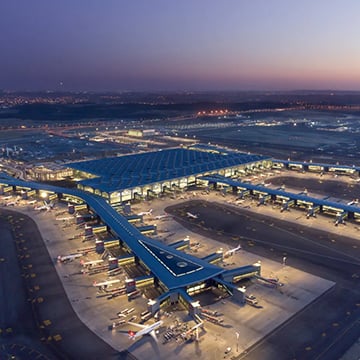
 Istanbul Airport was recorded as the busiest airport in Europe with an average of 1,459 daily departures and arrivals flights. According to the European Organisation for the Safety of Air Navigation (EUROCONTROL) published “European Aviation Report” for 24–30 November 2025, IST is at the very top, along with London Heathrow (LHR) and Amsterdam (AMS).
How Istanbul Airport became Europe’s #1 busiest hub
While other rival airports (for example, Heathrow or Amsterdam) cannot grow by increasing the number of takeoffs and landings, Istanbul Airport is not restricted by its size. IST focuses on operating many flights per day. Istanbul Airport flight operations create shorter waiting times for passengers between flights and it is one of the reasons why Istanbul Airport is the busiest airport in Europe.
Istanbul Airport’s Rise in Global Air Traffic Rankings
World-class hub of innovation and connectivity, Istanbul Airport, with its recent performance, shows a clear momentum because its year-over-year growth reached a strong 11%. When compared to pre-pandemic activity, its flight volume in 2025 is 31% higher than in 2019, which shows a significant increase. For comparison, ranking second among Europe’s top airports by traffic, Heathrow’s increase is 3%.
As the 9th busiest airport with 738 average daily flights, Istanbul Sabiha Gokcen’s increase comes the closest with the +24% since 2019. European network traffic has only returned to roughly its 2019 level, so Istanbul’s expansion stands out and shows how much the airport has advanced beyond its former scale.
Turkish Airlines Group plays a central role in the impact of Istanbul Airport on Europe’s aviation network because it operates an average of 1,486 daily flights and ranks as Europe’s second-busiest operator, and its activity is now 22% higher than in 2019. This scale supports a global network of more than 350 destinations, so it creates the volume needed for Istanbul Airport to function as a major transfer hub.
What the Future Holds for Mega Hub Istanbul Airport
 EUROCONTROL’s long-term forecasts show that Europe will grow at only about 1.9 percent per year, and this slow pace means that most hubs will expand only slightly. Istanbul Airport, the busiest airport in Europe, stands out because its traffic is already 31 percent above 2019 levels, so it is capturing far more growth than the continent as a whole. This outcome reflects the higher-end “Global Growth” scenarios in EUROCONTROL’s models, and it shows that new traffic is consolidating around airports that have modern facilities, available runway capacity, and a strong home carrier to support expansion.
European air traffic report shows that these trends have direct strategic implications for Türkiye because they confirm that its investment in large-scale airport infrastructure is producing long-term economic returns. Airlines operating in the region face new competitive pressures since Turkish Airlines’ flight activity is 22 percent higher than in 2019, while major European carriers remain below pre-pandemic levels, and this shift pushes more long-haul and connecting demand toward Istanbul.
Tourism gains as well because strong air connectivity supports Turkey's aviation growth and rising visitor numbers from regions such as the Middle East, and this broader network links travelers to more than 330 destinations. These advantages also justify continued investment in airport capacity, airline fleets, and tourism infrastructure because Türkiye is positioned to absorb most of the incremental traffic growth in Europe over the next two decades.